A First Tennis Match to Watch: Follow the Serve, Return and First Rally
Follow a first tennis match through the serve, return and opening rally to see how players shape a point before its outcome becomes obvious.
You settle into a seat just as a player bounces the ball, glances across the net and sends a serve towards the far box. In a first tennis match, follow that serve, the return and the opening rally in sequence; this small slice of play makes the point easier to read than trying to track every player and line at once.
Give the first few shots your attention
Tennis points can change direction quickly. A serve sets the ball in motion, a return answers it, and the first rally shots reveal whether either player has gained room to attack or needs to keep the ball in play. You do not need to predict the winner. Watch how each shot changes the next player’s options.
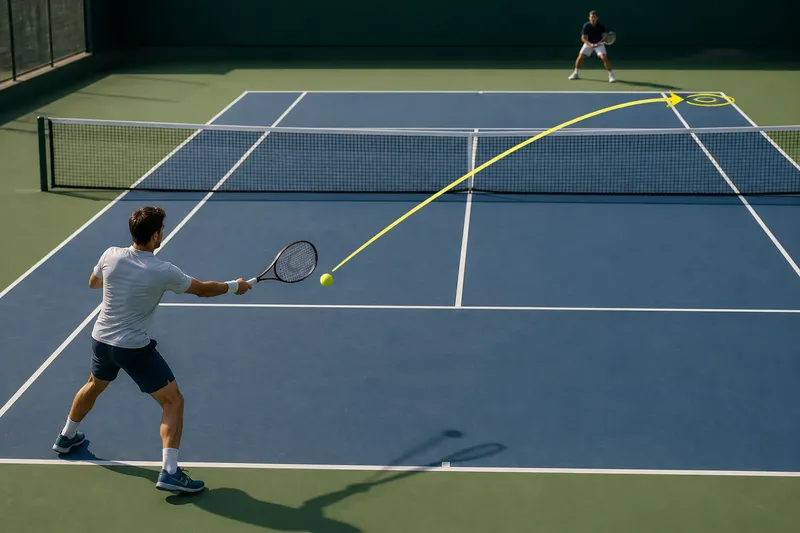
Start with the server’s position and the direction of the toss. Then watch where the ball lands and where the server moves after hitting it. On the other side, notice whether the receiver meets the ball early, backs away from it or is pulled towards the edge of the court.
Keep the focus narrow: ball, hitter, next likely contact. If you try to inspect the entire court, a quick exchange can become a blur. The aim is not to memorise technical terms but to connect each shot with a visible response.
Follow one hypothetical point from serve to result
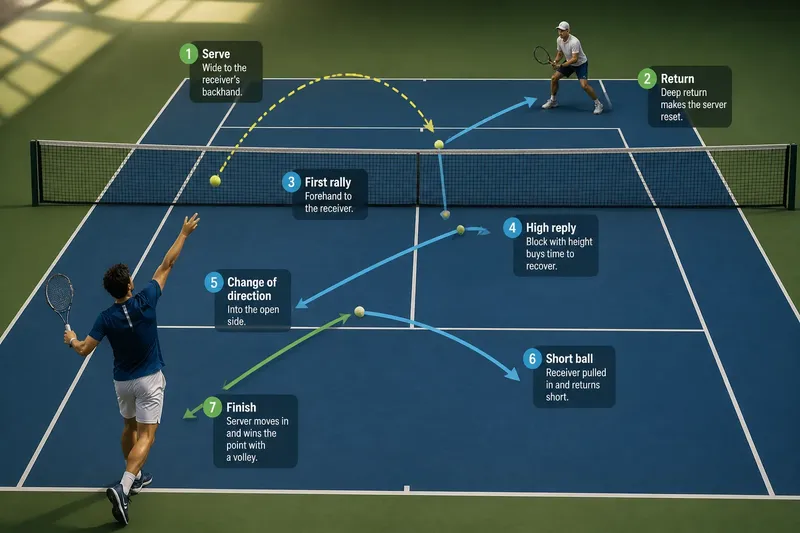
Imagine a hypothetical match on a hard court. The server has won the previous point and chooses a first serve towards the receiver’s backhand side. The receiver stands a little behind the baseline, ready to move either way. That starting picture gives you two things to watch: the serve’s direction and the receiver’s response.
The serve lands in the service box. The receiver shifts across, makes contact and sends the ball back deep. The return does not end the point, but it gives the server less time to move forward comfortably. Watch the server’s feet after the serve: instead of stepping in, the player recovers towards the middle and prepares for the next ball.
Now the opening rally begins. The server sends a firm shot towards the receiver’s forehand. The receiver blocks it back with height, buying time to recover towards the centre. The server then plays into the open side. The receiver reaches the ball and returns it short; the server moves forward and finishes with a volley.
The observable result is a point won by the server, but the useful story started earlier. The return made the server reset; the receiver’s high reply created recovery time; and the short ball gave the server a chance to move in. No single shot explains the whole point.
In a different point, the return might be weak and the server could attack immediately. Or a strong return might force a defensive shot, leaving the receiver in charge. Keep asking what the previous contact made possible, rather than treating each stroke as an isolated display.
Read the serve and return as a paired exchange
A serve is more than a way to start play. Its direction, height and pace influence how much time the receiver has and where they can make contact. You can often see the plan without knowing the serve’s technical name: look for the receiver’s movement and balance as the ball arrives.
The return is the receiver’s first chance to shape the point. A compact return may send the ball back safely; a more forceful one can put the server under pressure. Neither choice is automatically better. A difficult serve may make simply getting the return over the net a sensible response, while a comfortable ball may invite the receiver to aim deeper or change direction.
Also notice the server’s next position. A player who serves and stays near the baseline is preparing for another groundstroke. A player who moves towards the net is looking to close the point there. The receiver’s return can disrupt either plan, so follow the feet as well as the ball.
Use the opening rally to spot changing control
Once the return is in, watch for three visible clues: who has time to set up, who is moving while hitting, and who is forced to contact the ball farther from a comfortable position. These clues tell you about control without requiring a judgement about whether a shot was technically perfect.
A player moving sideways may still be in a strong position if the ball gives them time. A player standing near the middle may be under pressure if the incoming shot arrives quickly. Look at the quality of the next contact and the recovery afterwards; court position by itself can mislead.
Notice whether a player’s reply is deep, short, high or low. A deep ball can push an opponent back, while a shorter one may allow them to move forward. A high reply can offer time to recover, but it can also give the opponent a chance to attack. The point’s shape comes from the interaction between shot and response.
What should you watch in a first tennis match?
Where should I look when the serve is hit?
Begin at the server, then follow the ball into the service box and watch the receiver move to meet it. After contact, glance at the server’s recovery so you can see whether they are preparing to stay back or move forward.
How can I tell whether a return is effective?
Watch what it makes the server do next. If the server has to stretch, retreat or hit while off balance, the return has created a challenge; if the server can step into a comfortable shot, the return may have left an opening.
When does the opening rally begin?
It begins with the first shot after the return, not with the serve itself. Follow the next exchange or two to see whether one player can take time away, move the other around or regain a balanced position.
Do I need to know the score to follow a point?
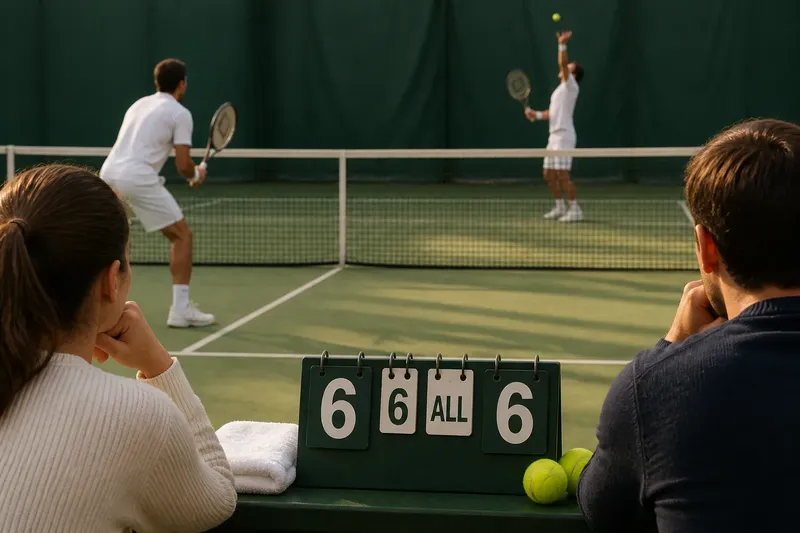
The score helps explain the match situation, but you can understand the point’s sequence without knowing every scoring term. Listen for the call before play resumes, then return your attention to the serve and the first exchange.
Make the next point easier to follow
When the point ends, take a brief pause before the next serve. Ask yourself which shot gave someone time, which shot forced movement and whether the server or receiver gained the first comfortable position. Then reset your attention at the next serve rather than carrying a prediction from the previous point.
Say you are watching from behind the baseline and keep losing sight of the ball during quick exchanges. For the next few points, imagine following only the receiver’s first contact after the serve, then the server’s reply. You should be able to notice whether the return changes the server’s position, even if the later rally remains too fast to track.
As the pattern becomes familiar, add one detail at a time: the direction of the serve, the receiver’s starting position or the server’s movement after contact. A first tennis match becomes much easier to read when you follow how one shot sets up the next. The most useful thing to watch is often not the last swing, but the first moment a player has to change their plan.