How Tennis Rackets Changed from Wood to Composite Frames
See how tennis rackets changed from wood to composite frames, and learn what material, head shape and frame design can—and cannot—tell you.
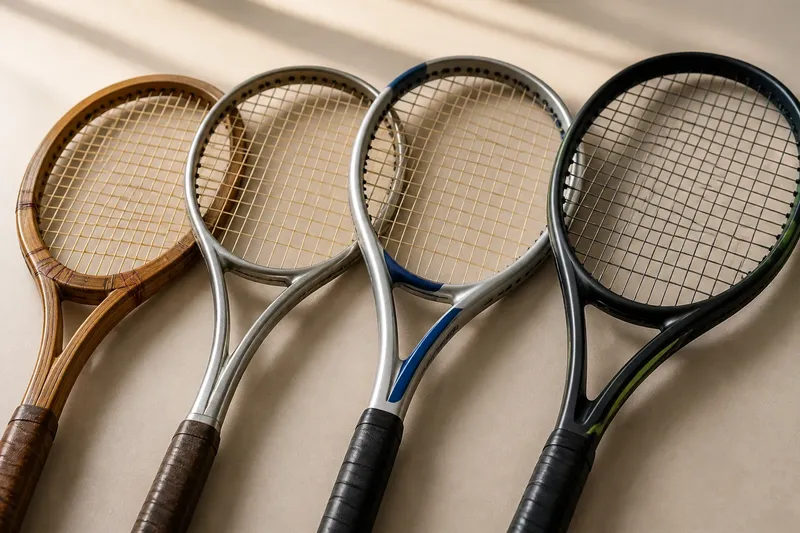
A wooden tennis racket’s compact head looks striking beside the broad oval of a modern composite frame. The change from wood to composite frames gave designers more options for shaping a racket’s profile, balance and feel, but the material name alone never tells the whole story.
Wood shaped the classic racket form
Traditional tennis rackets were made from laminated strips of wood. The material and construction suited a relatively compact head and a familiar, narrow frame. They also constrained how far designers could enlarge or reshape the hoop while keeping the racket practical to make and use.
A compact head gives the string bed a smaller area than a broad modern head. A ball struck away from the centre can feel less settled, though the response also depends on the individual frame, strings and construction. Wooden rackets were not all identical, and “wood” by itself does not describe how one played.
It is more useful to see wood as the starting point for a particular set of design possibilities, rather than as a failed version of a modern racket.
Metal broadened the design options
Steel and aluminium offered alternatives to laminated wood. Metal frames could be made with different profiles, and aluminium became a familiar option in recreational rackets. The change gave manufacturers new ways to shape the frame and consider how its mass and stiffness might affect the swing and contact feel.
Metal did not remove the design trade-offs. A racket still had to balance a sturdy frame with a manageable swing and a feel that suited its intended player. A broader head or a different profile can reflect manufacturing choices as well as a change in playing fashion.
Composite construction let designers tune the frame
Many modern rackets use fibre-reinforced composites: materials combined in layers, often with graphite fibres and resin. The construction can vary across the frame, giving designers options for shaping its sections and influencing how it flexes and where it carries mass.
That flexibility produced a wider range of designs, not one standard modern racket. A frame can be intended to feel quick to swing, or more substantial through contact. Those are design aims, not promises about how a particular player will perform.
Say a new player compares two composite rackets with similar-looking heads. One feels easier to bring round; the other feels steadier at contact. In this invented example, the player records those impressions and checks the full frame specifications, rather than assuming the word “graphite” explains the difference.
A larger head changes the string bed, not the whole racket
A larger head creates a broader string bed and changes the area available for contact. It also affects the racket’s proportions and can influence how it feels to swing. It does not make every off-centre hit behave alike, nor does it settle whether a racket will suit a particular player.
Head size needs to be considered alongside the frame’s weight, balance, stiffness and strings. Two rackets with similar head shapes can feel quite different, so a single visible feature is a poor shortcut to the whole design.
When comparing frames, treat head size as one clue among several.
Racket materials answer common questions?
Why did tennis rackets move beyond wood?
Wood construction limited the range of practical frame shapes and sizes. Metal and composite construction gave designers more ways to alter the head, frame profile and distribution of mass.
Are graphite and composite the same thing?
Graphite is a fibre used to reinforce many composite frames; “composite” describes a structure made by combining materials. The blend and construction can differ between rackets.
Does a larger head automatically make a racket easier to use?
No single feature settles how a racket will feel. Head size works alongside weight, balance, stiffness, strings and the player’s own swing.
How should a new player compare racket materials?
Compare complete rackets rather than choosing by material label. If possible, handle or try suitable options and notice comfort and swing feel; ask a qualified coach or racket specialist if you are unsure what suits your needs.
A useful way to compare racket designs
- Check the material description: if it names only graphite, then treat it as one part of the construction; otherwise, look for the maker’s fuller material description.
- Look at the head shape: if one head is visibly broader, then note the larger string-bed area; otherwise, do not assume the rackets share the same contact area.
- Compare the frame profiles: if the sections differ, then treat that as a design difference to consider; otherwise, remember that similar outlines can still conceal different construction.
- Check the stated weight and balance information: if the figures or descriptions differ, then expect a possible difference in swing feel; otherwise, do not assume the frames will feel identical.
- Notice the string setup: if the strings or tension differ, then avoid attributing every feel difference to the frame; otherwise, compare the frame and strings as a combined setup.
- Handle or try each racket if suitable options are available: if one feels uncomfortable or awkward to swing, then set it aside or seek advice; otherwise, keep it in consideration rather than treating one brief impression as a verdict.
For example, imagine a player choosing between two rackets. The first has a broader-looking head, a graphite-composite description and strings that feel firmer; the second has a narrower head, a different stated balance and a softer-feeling string setup. The player checks each frame’s specifications, handles both, and notices that the first feels easier to swing while the second feels steadier at contact. Because the strings differ, the player does not credit the frame alone for the contrast. The resulting choice is a trade-off: favour the first racket’s swing feel, or seek a comparable string setup before deciding whether the second frame’s contact feel is preferable.
The history of tennis rackets is not a march towards one perfect material. Wood established a compact form, metal widened the manufacturing options, and composites gave designers more ways to shape a frame. When you see a modern racket, its profile and head shape offer useful clues—but the full construction and setup are what make those clues meaningful.